

Data Archeology Platform
Make implicit data structures and lineage explicit across fragmented systems
Lineage visibility
Expose upstream and downstream data flows across systems, stores, and interfaces to establish factual traceability.
Schema & structure discovery
Infer schemas, field relationships, and implicit structures from heterogeneous and partially documented sources.
Transformation & dependency mapping
Identify how data is reshaped, aggregated, and consumed across pipelines, applications, and reporting layers.
Surface lineage, schema, and dependencies hidden in legacy data environments
3Pillar’s Data Archeology Platform makes implicit data structures explicit in complex and legacy environments. It is designed for situations where lineage is unknown, schemas are inconsistent, and transformation logic exists only in code, stored procedures, or operational behavior.
The asset focuses on structural discovery rather than governance policy or analytics tooling. It produces inspectable knowledge artifacts that describe how data actually exists and moves — including schema relationships, transformation logic, cross-system dependencies, and record-level lineage paths.
The platform operates in read-only or non-intrusive modes where possible. The goal is not to refactor or replace existing stores, but to generate an explicit, queryable representation of data structures and flows. This explicit knowledge reduces uncertainty in environments where documentation is incomplete, systems have evolved organically, or multiple data estates have been merged over time.
Outputs are structural and evidentiary in nature: mappings, lineage graphs, dependency matrices, and transformation records that can be examined, validated, and extended over time.
What the platform produces
Data Archeology generates explicit, inspectable records that describe how data is structured, transformed, and interconnected across systems. These outputs are structural artifacts rather than reports or dashboards — they serve as referenceable knowledge layers that can be validated, extended, and reused as environments evolve.
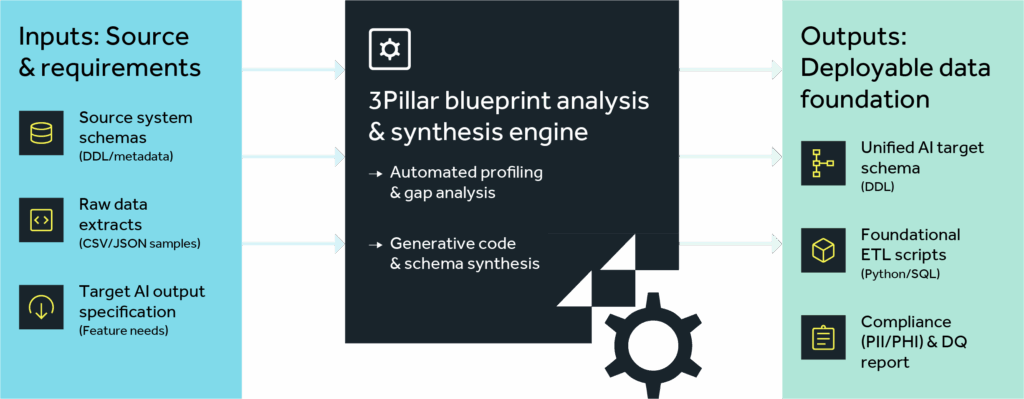
Lineage graphs
Visual and queryable representations of upstream and downstream data movement across systems, pipelines, and applications.
Schema maps & relationship models
Explicit definitions of tables, fields, entities, and inferred relationships across heterogeneous data sources.
Transformation records
Documented joins, aggregations, filters, and derived fields extracted from pipelines, scripts, and stored logic.
Dependency matrices
System‑to‑system and dataset‑to‑dataset dependency views that expose coupling, reuse, and propagation paths.
Structural metadata catalogs
Consolidated metadata describing structure, format, classification, and access characteristics without altering source stores.
Inspectable knowledge artifacts
Persistent, extensible records that can be reviewed, validated, and incrementally refined as environments evolve.
Key characteristics
Analyzes schemas, extracts metadata, and observes transformation logic without requiring modification of underlying data stores.
Connects datasets, interfaces, and applications into end‑to‑end lineage paths that reflect actual movement and usage patterns.
Identifies implicit relationships, normalization patterns, and structural inconsistencies across structured and semi‑structured sources.
Surfaces joins, aggregations, filters, and derived fields embedded in pipelines, scripts, and stored logic.
Produces lineage graphs, dependency matrices, schema maps, and transformation records that remain reviewable and extensible.
Applicable across legacy databases, data warehouses, cloud stores, and mixed on‑prem/cloud estates.

Achieved $1.75 MM in ROI driven by net new revenue and cost savings
“Through our partnership with 3Pillar, we’ve credentialed ourselves as the industry’s most creative, forward-thinking tech team.”
Chief Technology Officer
Top US Multiple Listing Service

75% reduction in volume of customer support calls
Launched new product quickly, allowing company to enroll new customers and increasing availability from 16 to 26 states in less than a year




Align. Adapt. Accelerate.
Upgrade your legacy applications to enhance security, improve performance, and reduce costs. Reach out today to get started.
Let’s Talk