

AI Responsible Engineering (AIRE) Framework
Benefit from accountable AI use across the SDLC
Decision traceability by design
Engineering decisions are recorded with ownership and rationale so change can be reviewed, explained, and audited over time.
Explicit system constraints
System invariants, acceptance conditions, and non-negotiable behaviors are formally defined so AI-generated change cannot violate intended system behavior.
Bounded AI execution
Clear rules define where AI may act, what it may modify, and what validation must pass before changes are accepted into production systems.
A cross‑disciplinary Responsible Engineering framework for AI‑assisted delivery
3Pillar’s proprietary AI Responsible Engineering (AIRE) framework makes AI use explicit, constrained, and inspectable across product definition, experience design, engineering, quality assurance, and delivery execution. It establishes decision rights, accountability, transparency, and structural guardrails so AI participation remains explainable and aligned with intended outcomes as systems evolve.
Instead of abstract principles or tool‑specific guidance, AIRE defines how intent, constraints, and decisions are expressed, recorded, and enforced as AI is introduced into day‑to‑day delivery. It clarifies what must remain stable, what may evolve, and how change is evaluated when AI systems contribute to design or execution—reducing the risk of shadow AI, opaque logic, and unmaintainable code.
This governance operates above individual tools and practices. AIRE establishes a consistent frame for how product, design, engineering, and quality teams specify expectations, record decisions, and validate change—so AI use remains controlled even as underlying technologies, workflows, and automation patterns shift. The framework embeds best practices and standards directly into working activities rather than separating policy from delivery.
AIRE applies wherever AI is used—whether augmenting individual activities such as coding, test generation, or review, or operating more autonomously within workflow‑ or agent‑based delivery—without redefining the underlying SDLC. It enables teams to scale AI adoption without forcing a choice between velocity and security.
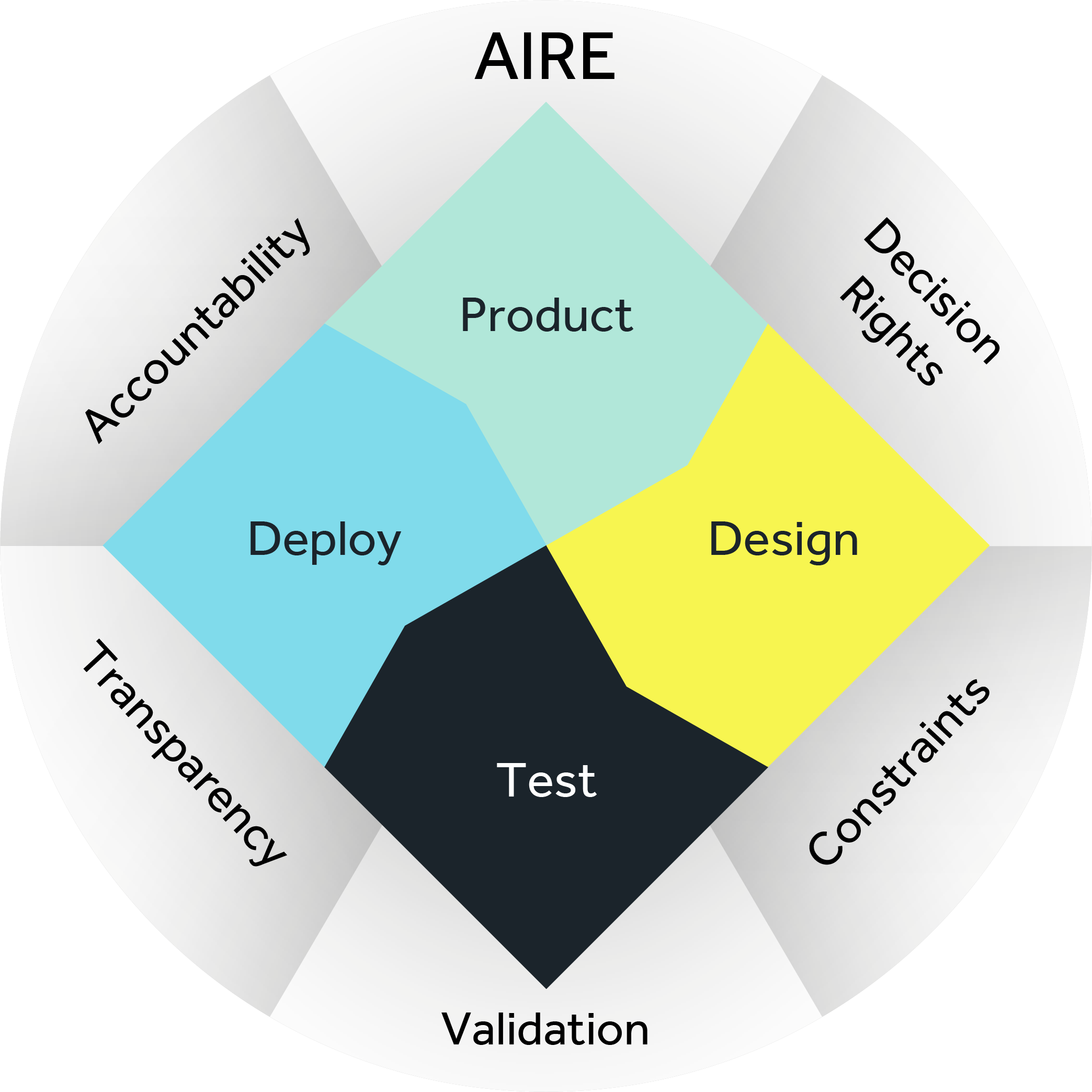
Governance embedded in delivery
AIRE does not sit outside delivery as policy or review.
Decision rights, constraints, validation, transparency, and accountability remain active throughout product, design, testing, and deployment—ensuring AI participation stays controlled as systems evolve.
How AIRE is applied
Rather than prescribing a single delivery model, AIRE provides structured working modes that embed governance directly into day‑to‑day execution. These modes adapt to organizational maturity, risk tolerance, and technical complexity while maintaining consistent standards of accountability and transparency.
Early solution framing
- Rapid modeling of system expectations and constraints
- Definition of decision boundaries and feasibility assumptions
- Creation of low‑fidelity technical assets or custom accelerators to validate direction
Structured delivery execution
- Alignment with existing agile or scrum practices
- Integration of validation and traceability into normal delivery workflows
- Continuous reinforcement of explicit constraints and decision records
Agent‑augmented and agentic workflows
- Bounded AI execution with human oversight
- Repeatable patterns for introducing autonomous or semi‑autonomous agents
- Preservation of accountability, auditability, and maintainability at scale
What AIRE governs
AIRE does not generate standalone deliverables. It codifies and enforces definitions, best practices, processes, development methodologies, and governance records that persist across tools, teams, and execution runs. Its purpose is to ensure AI participation remains controlled, auditable, and maintainable as delivery scales.
System expectation records
Explicit definitions of behavioral constraints, invariants, acceptance conditions, and non‑functional requirements that govern how systems may evolve.
Engineering decision records
Captured architectural and engineering decisions with ownership, context, and rationale—linking intent to implementation and preventing reliance on implicit knowledge.
Executable validation specifications
Machine‑evaluable specifications used directly in build, test, and validation workflows to ensure changes—human‑ or AI‑generated—can be verified.
AI participation rules
Auditable rules that define where AI may act, what inputs it may access, what constraints it must respect, and what validation must pass before outputs are accepted.
Delivery methodologies and practices
Structured working modes, repeatable development practices, and engagement‑ready approaches that embed governance directly into agile, scrum, and agent‑augmented delivery.
Governance and accountability structures
Defined decision rights, ownership models, and transparency mechanisms that clarify who is responsible for actions, outcomes, and approvals as AI participates in delivery.
Key characteristics
AIRE spans product, experience design, engineering, and quality practices, ensuring AI participation remains aligned across the full delivery lifecycle rather than isolated to a single team or function.
Decision rights, accountability, and transparency are built into delivery activities rather than managed through separate oversight structures.
AIRE prioritizes explicit processes and records that can be reviewed, queried, and enforced as systems change.
AI accelerates execution, but responsibility remains attributable. Ownership and rationale are explicitly recorded rather than embedded in generated output.
Checks and specifications are designed to run as part of normal delivery, ensuring AI‑assisted changes remain testable and explainable.
Built for environments where frequent change and AI participation increase variance—reducing ambiguity without introducing heavyweight ceremony or slowing delivery.


Achieved $1.75 MM in ROI driven by net new revenue and cost savings
“Through our partnership with 3Pillar, we’ve credentialed ourselves as the industry’s most creative, forward-thinking tech team.”
Chief Technology Officer
Top US Multiple Listing Service

75% reduction in volume of customer support calls
Launched new product quickly, allowing company to enroll new customers and increasing availability from 16 to 26 states in less than a year




Align. Adapt. Accelerate.
Upgrade your legacy applications to enhance security, improve performance, and reduce costs. Reach out today to get started.
Let’s Talk