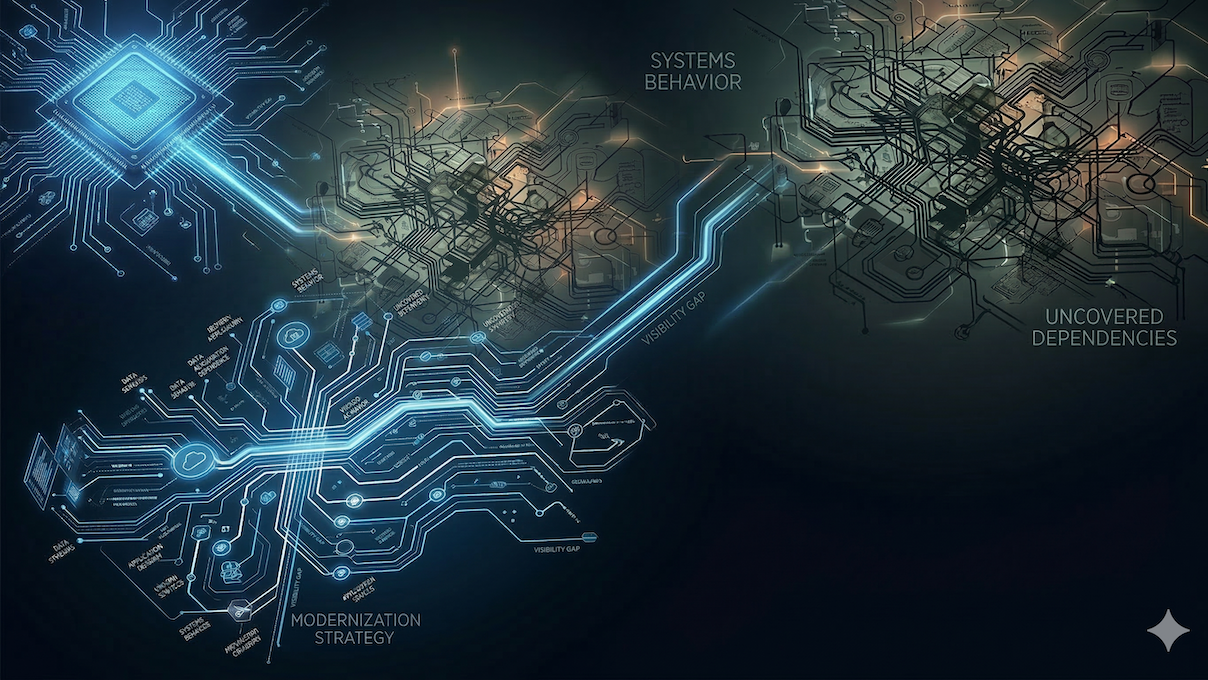
Why Modernization Programs Stall — Even When Strategy Is Clear
Most modernization programs don’t fail for the reasons executives expect. They fail because organizations often underestimate the complexity of the systems they are trying to change—complexity created by years of hidden dependencies, undocumented logic, and evolving integrations.
This is easy for leadership teams to overlook. By the time a modernization program begins, the strategic case is already clear. Executives understand the pressures—legacy architectures limit scalability, technical debt inflates operating costs, and aging systems constrain AI initiatives and innovation.
The roadmap is approved and the investment is justified.
Yet months later, progress slows. Timelines slip. Teams uncover previously unknown dependencies and unexpected behaviors. Seemingly straightforward changes trigger cascading failures across systems no one realized were connected.
At first glance, this slowdown can look like an execution problem. But the root cause usually is not execution, nor is it strategy. The real problem lies in the system itself—and how little of it teams can actually understand.
The strategy–execution disconnect
Modernization discussions typically start with strategic goals. Leaders focus on outcomes such as:
- migrating to cloud-native infrastructure
- decomposing monoliths into services
- improving delivery velocity
- enabling advanced analytics or AI
These goals are common across the industry and shape how organizations approach modernization. Teams then work to achieve them through familiar strategies—rehosting, replatforming, refactoring, rearchitecting, or replacing systems.
But modernization strategy operates at the architectural level—the high‑level blueprint of how systems are supposed to be structured.
Execution happens inside the actual system that exists today: the code, integrations, data flows, and business rules that have accumulated over years of development and change.
In theory, the blueprint and the system in production should match. In practice, they rarely do.
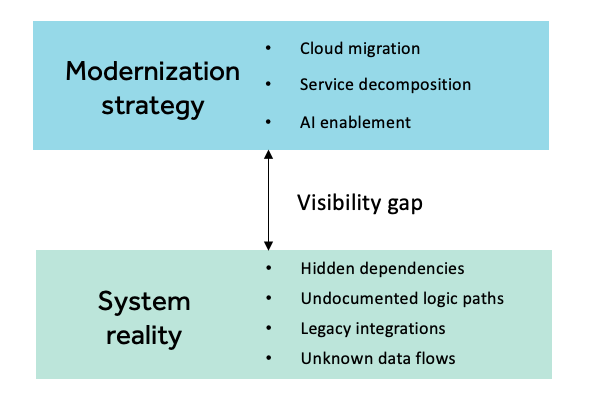
Modern systems evolve constantly through feature releases, emergency patches, integrations, and operational workarounds. Over time, the production instance can look very different from the architecture diagrams that describe it.
When modernization begins, teams are often working from a simplified view of the architecture while trying to modify a far more complex system underneath it.
That mismatch between the plan and the underlying system is where many modernization programs begin to slow down.
The visibility gap
As systems evolve, maintaining a clear view of how they actually behave becomes increasingly difficult. As a result, when teams try to understand the environment they are working in, they often rely on several familiar sources of insight:
- architecture diagrams that reflect past design intent
- documentation that has not been updated in years
- static analysis tools that reveal structure but not behavior
- institutional memory held by a handful of long-tenured engineers
Each of these sources is helpful. None provides a complete representation of the system.
The result is a persistent visibility gap between how the system is believed to operate and how it actually behaves in production.
Why incremental modernization still struggles
Recognizing the risks of large-scale rewrites, many organizations intentionally pursue incremental modernization. This approach—often inspired by patterns such as the Strangler Fig—is generally sound. Breaking a transformation into smaller changes reduces disruption and allows teams to learn as they go.
But incremental modernization introduces a different challenge: instead of making one large decision, teams must make hundreds of smaller decisions. Each step requires answering dependency and impact questions such as:
- What else depends on this module?
- Which services consume this data field?
- Where does this business rule actually influence downstream behavior?
When teams don’t have complete answers to these questions, every decision is based on a hypothesis. And when modernization proceeds on hypotheses rather than evidence, the consequences often surface only after changes reach production.
The ongoing discovery cycle
Discovery rarely happens just once at the beginning of a modernization program; it repeats continuously throughout execution.
Over time, this creates an ongoing discovery cycle that forces teams to spend extra time and energy understanding the system. Teams pause development to investigate unexpected system behavior and trace how components interact under real conditions. These investigations consume engineering time that was never planned in the modernization roadmap.
As these discovery cycles accumulate, delivery slows. Programs appear to lose momentum. Leadership begins to perceive modernization as inherently unpredictable. In reality, the strategy may be perfectly sound. The friction comes from the absence of a reliable model of system behavior.
The real constraint
Taken together, these patterns point to a deeper issue. The gaps and cycles described above all stem from the same underlying problem: organizations cannot clearly see how their systems actually behave.
For many organizations, the true constraint on modernization is not ambition, architecture, or engineering capability—it is the absence of reliable system visibility.
Modernization becomes dramatically easier when teams can clearly understand how their systems behave in production, how components interact, which dependencies shape critical workflows, and where safe boundaries for change exist.
Before organizations can safely change complex systems, they must be able to clearly see how those systems behave.
When those answers are visible, modernization stops feeling like exploratory surgery. It becomes controlled engineering.
Sequencing improves. Risk becomes visible earlier. Execution accelerates.
A leadership shift
For technology leaders, the implication is straightforward: modernization should begin with system understanding.
Before accelerating transformation, leading organizations first establish reliable system visibility—a clear, continuously updated view of how applications, data, and services interact in production.
With that clarity in place, modernization decisions become far more predictable. Dependencies surface earlier, change can be sequenced safely, and engineering teams move faster with less risk.
Strategy may define the direction. But system clarity determines whether modernization succeeds.
If your teams can’t clearly answer how your systems behave in production, modernization will continue to slow down—no matter how strong the strategy is. The first step isn’t accelerating delivery. It’s establishing system visibility.
Read more on how leading teams are making system behavior observable before they modernize.